
I’m sure you are familiar with the term ‘Market Analysis’ if you are a budding business idea owner. On this topic, we will look at using SWOT and the 4 ‘P’s as a tool to make informed decisions for our business.
Market analysis is a pivotal component of effective business planning. By examining the environment in which a business operates, it empowers entrepreneurs to make informed decisions, seize opportunities, and mitigate risks. Two key tools that aid in this process are the SWOT analysis and the 4 Ps of marketing, collectively shaping the path to success.
1. SWOT Analysis: Assessing Internal and External Factors
‘Strengths’ and ‘Weaknesses’ pertain to internal factors. Businesses scrutinize their capabilities and limitations to leverage strengths and address weaknesses. For instance, a skilled workforce can be a strength, while outdated technology might be a weakness. ‘Opportunities’ and ‘Threats’ are external aspects. Identifying trends and shifts in the market landscape, businesses can capitalize on opportunities and proactively combat threats. This comprehensive analysis offers insights into competitive advantages and areas needing improvement.
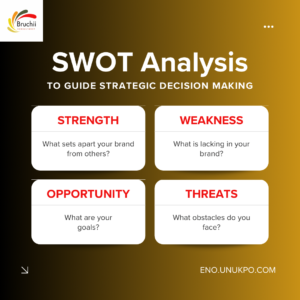
Examples of Market Analysis using SWOT
1. Strengths: A local bakery discovers that its handcrafted pastries and unique flavor combinations are highly praised by customers, giving it a competitive advantage in the market.
2. Weaknesses: An electronics manufacturer realizes that its production process is inefficient, leading to higher costs and longer lead times compared to competitors.
3. Opportunities: A solar energy company identifies a growing trend towards renewable energy sources, creating an opportunity to expand its product offerings and capture a larger market share.
4. Threats: An e-commerce startup recognizes the threat of increasing competition in its niche, prompting the need for innovative marketing strategies to stand out.
4 Ps of Marketing:
1. Product: Apple introduces the iPhone with innovative features like Face ID and a dual-camera system, catering to customers’ desire for advanced technology and aesthetics.
2. Price: A new coffee shop strategically prices its beverages slightly lower than established competitors to attract price-sensitive customers while maintaining quality.
3. Place: A sportswear brand partners with major fitness centers to sell its products exclusively within their premises, ensuring a targeted audience and enhancing brand visibility.
4. Promotion: An upcoming movie studio creates a buzz by releasing teaser trailers, organizing exclusive premieres, and engaging with fans on social media to build anticipation for its new film.
2. The 4 Ps of Marketing: Crafting a Comprehensive Strategy
Product: This entails designing the right product or service to meet customer needs. Elements such as features, quality, branding, and packaging are essential considerations.
Price: Pricing strategies must reflect customer perceptions and market conditions. Entrepreneurs decide whether to position their offering as a luxury item, a budget-friendly option, or somewhere in between.
Place: Determining the distribution channels is crucial. Businesses must evaluate whether to sell directly to consumers, through intermediaries, or online platforms, ensuring the product reaches the target audience efficiently.
Promotion: Marketing efforts encompass advertising, public relations, sales promotions, and more. Crafting a compelling message and utilizing appropriate channels amplifies the product’s visibility and generates demand.

Integrating SWOT Analysis and the 4 Ps: Guiding Business Decisions
Combining SWOT analysis and the 4 Ps enables a comprehensive view of the market and informs business strategy. A strong alignment between these two frameworks enhances decision-making by allowing businesses to capitalize on strengths, address weaknesses, seize opportunities, and mitigate threats while creating a compelling marketing strategy.
Identifying Synergies: By understanding internal strengths and weaknesses, businesses can tailor their products and services to align with consumer demands. This synergy ensures that the offering resonates with the target audience and has a competitive edge in the market.
Strategic Pricing: A well-informed pricing strategy considers both internal capabilities and external market conditions. A business with a unique value proposition might opt for premium pricing, while one focusing on affordability might adopt a penetration pricing approach.
Effective Communication: Integrating promotion strategies with SWOT insights fosters more impactful communication. Addressing threats head-on and highlighting strengths creates authentic messaging that resonates with consumers, fostering trust and brand loyalty.
Adapting to Change: The dynamic nature of markets necessitates continuous analysis and adaptation. Regularly evaluating SWOT factors and reassessing the 4 Ps ensures that a business remains agile and responsive to evolving market trends.
In conclusion, market analysis is the compass that guides businesses through the complexities of today’s competitive landscape. The synergy between SWOT analysis and the 4 Ps of marketing empowers entrepreneurs to make informed decisions, devise impactful strategies, and carve a distinct niche in the market. By unveiling insights into both internal and external factors, these tools equip businesses with the knowledge to navigate challenges, seize opportunities, and thrive in an ever-changing business environment.
Read also Goal Setting

- Nigerian Business License Guide - October 25, 2023
- Know Search Engine Optimization SEO - September 28, 2023
- META: Features For Businesses 2023 - September 26, 2023